
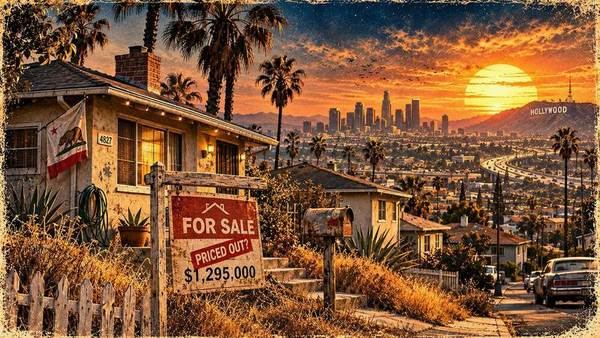
California Dreaming Is Dead: When a Middle-Class Income Stops Buying a Middle-Class Life
For decades, America has defined the middle class largely by income. But income alone may never have been what made someone middle class. What mattered was what remained after the necessities were paid: enough to save, buy a home, survive an emergency, raise a family and gradually build something that belonged to you.
The middle class, in that sense, is not simply an income category. It is an economic position built on having enough left over to move forward. A household may still earn what looks like a respectable salary, but when housing and basic living expenses consume nearly all of it, the paycheck can remain middle class while the future it once purchased disappears.
That is where the divide begins. The wealthy already own things: homes, businesses, investments and other assets that can rise in value and create more wealth. Some lower-income households may survive through rent-controlled housing, subsidized housing, family housing or other forms of support that help them remain in place. The middle class sits between those two worlds. It earns enough to support itself, but traditionally also enough to save, buy property and build security over time.
That is the break. Rising home prices push ownership farther out of reach for people trying to enter the market, while those who already own may see their homes rise sharply in value. This is also where the middle class gets trapped. A homeowner may be wealthier on paper, yet selling often means buying back into the same expensive market. Rising prices can create equity while reducing the freedom to move.
In California, that leaves the middle with fewer choices: stay and become increasingly stretched, take on more debt, or leave. The wealthy are better positioned to stay because they have the capital to absorb higher prices and continue buying or investing. Some lower-income households may remain through housing protections and assistance. The middle is particularly exposed to losing mobility. The poor may find ways to stay. The wealthy can afford to stay. The middle is increasingly pressured to lose ground or move out.
That is what makes housing more than an affordability problem. It becomes a mechanism that can widen the distance between classes. A home is not only shelter. It is also one of the main ways American households have historically turned years of work into equity and long-term security. When entry into ownership becomes harder and existing owners become locked into increasingly expensive markets, that pathway begins to weaken.
The danger is not that everyone suddenly becomes poor. It is that the space in between becomes smaller. A country can remain wealthy while the middle class loses the ability to move upward inside it.
This insight ultimately became California Dreamin’s Dead, written by songwriter Brice Salek for We So High and released November 5, 2026, through Ringtone Records 26. California has long represented possibility, but when the cost of staying begins to push the middle out, even the Sunshine State can start to feel like the sun is going down on the dream itself.
Listen to the song
Listen to We So High’s California Dreamin’s Dead: